How Casino Language Shapes Lâm Đồng’s Public Image
Learn how casino language in Lâm Đồng shifts across public wording and translation, so you can describe a phrase accurately without implying more than it says.
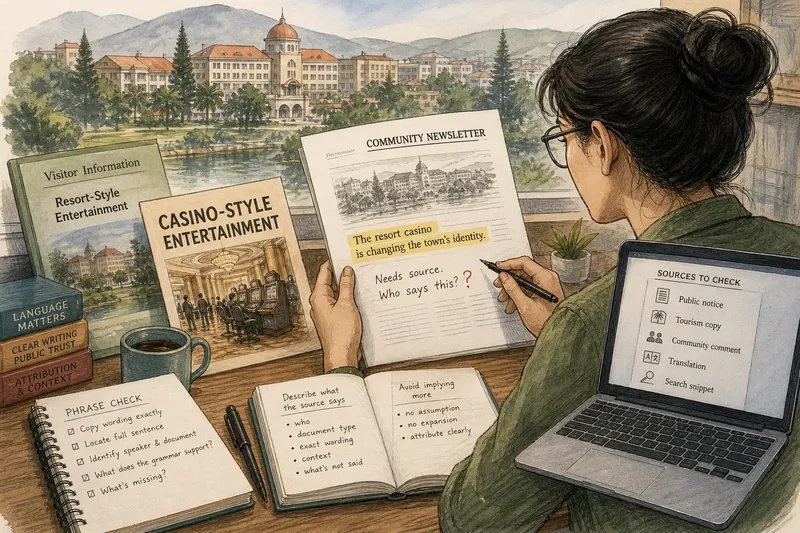
A leaflet calls something “casino-style entertainment,” while a headline shortens it to “casino.” To describe casino language in Lâm Đồng accurately, check what each phrase names, who uses it, and what the sentence actually claims.
What does “casino” mean in a sentence?
“Casino” may name a venue, a type of activity, or a subject people are discussing. The surrounding words help distinguish those uses. “Proposes,” “imagines,” and “operates” describe different relationships to the term; none should be swapped for another.
Read the subject and verb together. If a sentence says a writer “imagines a casino,” report an idea in a text, not an operating place. If it says a notice “defines casino-style entertainment,” describe the wording in that notice rather than expanding it into a claim about a venue.
Before repeating a label, identify its grammatical role: is it naming a place, modifying another noun, or appearing as a topic of discussion?
How do “resort” and “entertainment” change the wording?
“Resort” points toward a hospitality setting, while “entertainment” can describe an activity or serve as a broad promotional category. Their presence does not settle what “casino” means in a particular sentence.
Check how the words connect. “Resort casino” may function as one compound label, while “resort and casino” may list two separate subjects. If the source does not clarify the relationship, quote its wording and leave that relationship unresolved.
Pay attention to modifiers such as “style,” “themed,” or “inspired.” They can signal resemblance or framing rather than identify a specific kind of venue.
How can you describe a phrase before repeating it?
Use this short phrase check: copy the wording exactly, locate the full sentence, identify the speaker and document type, then decide what the grammar supports. Record any missing context before drafting your description.
- Headline: If the article body supports the headline’s exact claim, attribute it to the report; if the body qualifies it, describe the narrower claim instead.
- Public notice: If the notice defines a term or names an activity, quote that wording with its surrounding sentence; if it leaves the term unexplained, do not supply a definition.
- Tourism copy: If “resort” or “entertainment” appears as promotional framing, identify it as the copy’s wording; if it makes a concrete claim, include it only with the details the source provides.
- Community comment: If a speaker explains what a label means to them, attribute that interpretation to the speaker; if no explanation is given, do not infer one.
- Translation: If an English equivalent changes the tone of the original, retain the source term and note the uncertainty; if the meaning is clear in context, translate without adding implications.
- Search snippet: If the snippet cuts off the sentence, open the full source before describing the claim; if the full source cannot be read, state that the wording is incomplete.
What do readers ask about casino language?
Does “casino” always name a physical venue?
No. It can appear as a broad category or a topic of discussion. Check whether the sentence identifies a place or uses the term more generally.
What should you do with “resort casino” when the link is unclear?
Quote the phrase and say the source does not explain how its terms relate. Do not turn the wording into a claim about a particular property.
How should you handle an uncertain translation?
Keep the original term beside a cautious translation when nuance matters. For formal or public-facing language, consult a fluent speaker or qualified translator if the distinction could change the meaning.
Can one speaker’s wording stand for local opinion?
No. Attribute the words to that speaker rather than to Lâm Đồng residents as a group. A broader claim needs broader, clearly identified context.
How can you revise an unclear description?
Imagine an editor reviewing an invented community newsletter. The draft says, “The resort casino is changing the town’s identity,” but gives no source for the label or the claim about identity. The editor first marks “resort casino” as the newsletter’s own phrase, then removes the unsupported claim about change. The revised sentence reads: “The newsletter uses the phrase ‘resort casino’ while discussing how the town is described.” Its observable result is narrower: the sentence reports the newsletter’s wording without asserting that a venue exists or that residents share one view.
For clear writing about casino language in Lâm Đồng, name the speaker and document, preserve the phrase that matters, and state what the wording leaves unanswered. That gives readers the language they need to interpret without treating a label as evidence for a larger claim.