How Casino Scenes Changed Across Film History
Casino scenes across film history reveal how filmmakers use gambling rooms for spectacle, suspense, or character conflict—and how to read those choices.
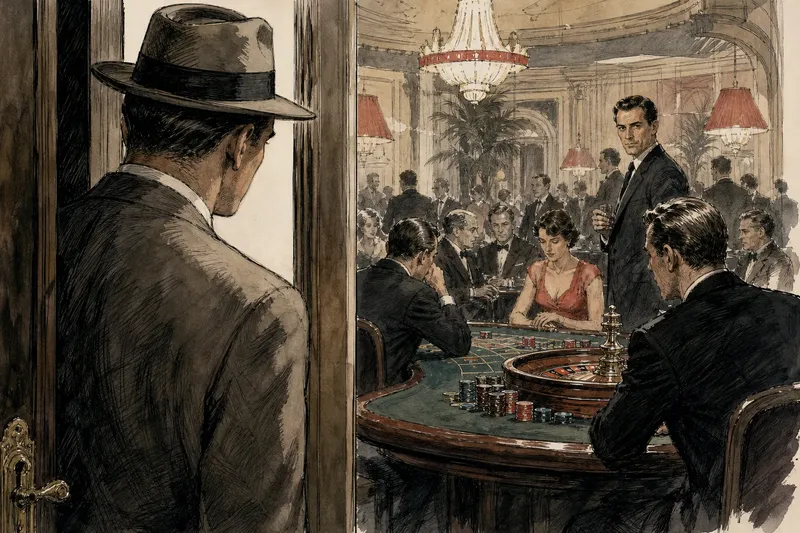
A crowded gaming room can make a film feel glamorous, tense, or both. Casino scenes across film history work less as records of real venues than as carefully staged spaces where filmmakers bring characters together, give them something to risk, and control what viewers notice.
How did early films make gambling visible?
Silent films relied on movement, gestures, and objects to communicate. A card, a player’s pause, or a companion’s reaction could carry a scene without spoken explanation. Gambling suited that visual approach because the audience could follow the action through the players’ faces and hands.
As sound cinema developed, gambling rooms could also function as social settings. In Casablanca (1942), Rick’s café includes a roulette table amid its larger mix of conversation, money, and encounters. The room helps bring characters into one shared space; it is not presented as a modern casino resort.
When you watch an early gambling scene, track what the camera makes legible: the game, the people watching, or the relationships around the table.
Why did crime films turn casinos into systems?
Crime stories can use a casino to concentrate crowds, rules, money, and surveillance in one setting. That gives a filmmaker ways to stage access and concealment. The room can appear orderly to visitors while the plot follows a private scheme beneath that public surface.
Ocean’s 11 (1960) builds its heist story around Las Vegas casinos, making the venues part of the characters’ problem rather than mere decoration. Martin Scorsese’s Casino (1995) places its crime story within a stylized view of Las Vegas operations and spectacle. Neither film should be treated as a practical account of how a casino works; each arranges its setting to serve its narrative.
Watch who can move freely, who gets watched, and which spaces the film keeps out of view. Those choices often reveal the story’s idea of power.
How can a casino scene reveal character?
A gambling room can shift from spectacle to character drama when the film focuses on decisions and their effects. In Rain Man (1988), the Las Vegas blackjack sequence is tied to the relationship between Raymond and Charlie. The table matters because of what the brothers’ actions bring out in their bond, not just because a game is underway.
To read a scene, note the character’s aim, the choice made at the table, and the reaction that follows. If the scene changes how two people treat one another, the game is doing story work. If it mainly presents lights, clothing, and a broad view of the room, spectacle may be its main purpose.
What do viewers ask about casino scenes?
Which film first showed a casino?
There is no single starting point established here. Early gambling scenes belong to cinema’s silent era, but naming a first film would require a verified historical survey rather than an inference from a handful of examples.
Why do crime stories use casinos?
A casino setting lets a film bring crowds, rules, money, and observation together. Those elements can support a story about planning or concealment without making the film a reliable guide to real operations.
Do screen casinos represent actual venues?
Not necessarily. Sets, editing, and performance are arranged for the story, so a scene’s visual details do not establish what a particular venue looks like or permits.
How can I tell whether a scene emphasizes spectacle or character?
Look for the camera’s attention: broad views and entrances often foreground the room, while decisions and their consequences foreground people. A scene may combine both, so consider what changes by the final reaction.
How should you read casino scenes across film history?
Compare the scene’s purpose rather than assuming the setting means the same thing in every period or genre. A silent sequence may depend on gesture; a heist film may emphasize access and watchfulness; a relationship drama may use a game to expose trust. These are differences in storytelling, not a timeline in which one use simply replaces another.
Say you are watching an invented scene in a fictional resort: a wide shot shows a gaming table, a character stops at the doorway, and another person watches from across the room. First, record those visible details without attaching them to a real location. Next, note the doorway pause and the watcher as clues to how the scene builds tension. Then ask what the character does after noticing the watcher; if the character turns away, the scene may frame the room as a source of pressure, while approaching the table would point toward a different choice. The result is an interpretation of the scene’s staging, not evidence about a venue in Lâm Đồng.
For a specific place, rely on that place’s own current visitor information rather than a film image. Treat casino scenes across film history as evidence of cinematic choices, and keep local descriptions tied to verifiable local sources.
A useful habit is to separate what the frame shows from what the plot asks you to infer. That distinction lets you discuss a casino scene precisely without turning its atmosphere into a claim about real life.